An F&B idea becomes investable only after its site, catchment, operating format, capacity, menu, approvals and unit economics have been tested together. By the end, you will know which documents are reviewed first, how Delhi NCR locations are compared, how alternative concepts are scored, and what evidence is required before feasibility sign-off.
Key takeaways
- Start with an operating brief covering customers, pricing, location and service channels.
- Test the catchment against delivery, dine-in, competition and local NCR demand.
- Compare formats before committing to a menu, site design or investment plan.
- Use a pilot and feasibility sign-off to expose operational and financial risks.
The process starts with an operating brief, not a logo
The first deliverable is an operating brief, not a logo or a menu. It records what the business must sell, to whom, where, at what price, and through which service channels before the concept team develops options.
1. Capture the promoter’s objective, investment range, target opening date, proposed site, carpet area, ownership or lease status, and appetite for expansion or franchising.
2. Define the customer and occasion: office lunch, family dinner, quick breakfast, delivery, celebration, institutional feeding, or another specific need. Record expected dayparts, average transaction value, seating capacity, covers or orders per day, table turns, takeaway share, and delivery share.
3. Document the customer promise, menu direction, production method, service format, staffing approach, and required kitchen output. Note restrictions such as vegetarian production, halal handling, central production, alcohol, or late-night service.
4. Inspect the premises for access, parking, exhaust routes, electrical load, water, drainage, grease management, delivery staging, storage, fire exits, and permitted use. Identify the exact authority in Delhi, Gurugram, Noida, Ghaziabad, or Faridabad because NCR has no single municipal approval process.
5. Build the initial feasibility file: rent or occupancy cost, food and packaging cost, payroll, utilities, commissions, capex, opening inventory, working capital, and sensitivity ranges for sales. This is the foundation of food business concept development in Delhi and exposes a weak assumption before design begins.
The catchment and site are tested against real NCR demand
A site passes the demand test only when its reachable customers can support the intended sales at realistic capacity. In F&B concept development in NCR in Delhi, consultants map a trade area by travel time, not a simple radius, then separate weekday and weekend demand by occasion and daypart.
The assessment combines site visits, pedestrian and vehicle counts, office and residential mapping, competitor observation, delivery-platform density, parking checks and interviews with nearby users. A five-minute walk may define a café’s core catchment; a destination restaurant may depend on a 20-minute drive and reliable parking.
The demand model records:
- Expected covers or orders by breakfast, lunch, evening and late-night periods
- Average transaction value, table turns, seat utilisation and takeaway share
- Delivery demand, rider access, packaging space and platform commissions
- Competitor pricing, occupancy, cuisine gaps and visible peak-hour queues
- Fire access, exhaust routing, grease and wastewater arrangements, electrical load, refuse storage and permitted use
| NCR location | Demand and access question |
|---|---|
| Delhi | Does restricted parking, dense competition or a short-distance customer base limit volume? |
| Gurugram | Can office-led weekday demand compensate for rent pressure and weekend variation? |
| Noida | Are sector access, residential density and evening traffic sufficient for the format? |
| Ghaziabad | Can the catchment support the price point after commute and visibility are tested? |
| Faridabad | Will local demand justify the proposed capacity without relying on distant customers? |
The model then tests base, downside and upside cases. A site that works only with full seats, peak delivery and uninterrupted access is not yet feasible.
Alternative formats are compared before one concept is selected
An owner’s initial idea is compared against each format using the same tests: demand, access, capacity, approvals, menu complexity, staffing, investment and unit economics. This prevents a strong brand idea from hiding weak delivery access or an impossible kitchen.
| Format | Best measured by | Common risk |
|---|---|---|
| Dine-in | Covers, table turns, average check and seat utilisation | Rent and fit-out overwhelm weekday demand |
| Café | Daypart traffic, beverage mix and dwell time | Seats stay occupied without enough spend |
| Cloud kitchen | Orders by delivery zone, commission and dispatch speed | Kitchen output exceeds rider access or demand |
| Takeaway | Walk-in orders, queue time and packaging cost | Low seating limits higher-value occasions |
| Food court | Footfall, lease terms, common-area rules and peak throughput | Shared services restrict extraction or storage |
| Catering | Events, production batches, transport and holding time | Irregular demand strains labour and working capital |
| Institutional | Served population, peak meals per hour and service levels | Daily averages conceal a peak-capacity failure |
1. Convert the preferred format into a demand model by daypart, then test average check, food and packaging cost, payroll, occupancy, commissions, utilities, capex and working capital. Use sensitivity ranges, not one revenue forecast.
2. Check the physical envelope before menu lock: exhaust, electrical load, grease management, cold storage, hand-wash points, raw-to-ready flows and delivery access.
3. Confirm the exact authority and premises use. Delhi, Gurugram, Noida, Ghaziabad and Faridabad follow different municipal processes, so foodservice concept planning NCR in Delhi must identify approvals before the financial case is finalised. For institutional foodservice concept planning in NCR, Delhi teams must also document nutrition standards, special diets, transport, traceability and service remedies.
The preferred concept is converted into a site, menu and financial test
Before signing the lease, test the selected concept against the actual premises, proposed menu and minimum viable sales. The purpose is to find a fatal constraint while relocation or redesign is still possible.
1. Confirm the operating fit. Check seating, table turns, covers or orders by daypart, kitchen throughput, storage, dishwashing, receiving, waste removal, delivery dispatch and staff circulation. A site that fits 60 seats on paper may not support the exhaust, aisle widths, wash-up area or production volume those seats require.
2. Test the regulatory envelope. Identify the exact authority—Delhi, Gurugram, Noida, Ghaziabad or Faridabad—and verify permitted use, operating-hour restrictions and approval routes. Map FSSAI activity categories in FoSCoS for restaurant, caterer, manufacturer, storage or transport operations.
Check fire exits, travel paths, occupancy, LPG storage, electrical load, kitchen exhaust and firefighting provisions before promising a seating count.
3. Stress-test the menu. Cost every dish by recipe yield, food cost, preparation time, equipment requirement and packaging. Remove items that need unavailable exhaust, excessive cold storage, separate specialist equipment or a production step the premises cannot support.
4. Build unit economics using average check, seat utilisation, table turns, delivery orders, food and packaging cost, payroll, rent, commissions, utilities, maintenance, opening inventory, capital expenditure and working capital. Run low, base and high cases; a concept that survives only the high case is not lease-ready.
An f and b feasibility consultant in delhi should record each assumption, evidence source and unresolved approval in a decision log. Lease commitment should wait until the physical, regulatory and financial tests agree.
A pilot and feasibility sign-off expose the risks that projections miss
A profitable spreadsheet is not a sign-off. The final gate needs evidence that the proposed operation can deliver its promise at the selected site, within the available capital and opening timetable.
Review one decision pack containing:
- Pilot records showing prep time, ticket time, portion yield, food waste, packaging performance, customer acceptance and repeat orders
- The revised unit-economics model, with covers or orders, average transaction value, food cost, payroll, rent, commissions, utilities, capex and working capital tested across low, base and high cases
- Supplier quotations for equipment, exhaust, refrigeration, furniture and opening inventory, rather than allowances copied from another project
- A licensing matrix identifying the local authority in Delhi, Gurugram, Noida, Ghaziabad or Faridabad, plus the relevant FSSAI category through FoSCoS
- Landlord and authority confirmations covering permitted use, exhaust routes, electrical load, LPG, fire exits, occupancy and fire-safety provisions
- The staffing plan, opening schedule and risk register with an owner and deadline for every unresolved item
A food business concept development in Delhi becomes decision-ready when each assumption is labelled validated, benchmarked or untested. A specialist f and b feasibility consultant in Delhi can challenge the model against pilot logs, quotations and written confirmations instead of treating every input as fact.
Vinship Restaurant Consultant can use that evidence trail to identify what can be funded now and what requires another pilot, landlord approval or authority confirmation before lease commitment.
Related products
 | F&B Concept & Feasibility Consulting A food and beverage venture begins with an idea, but a commercially usable concept requires more than an attractive theme or menu idea. View product → |
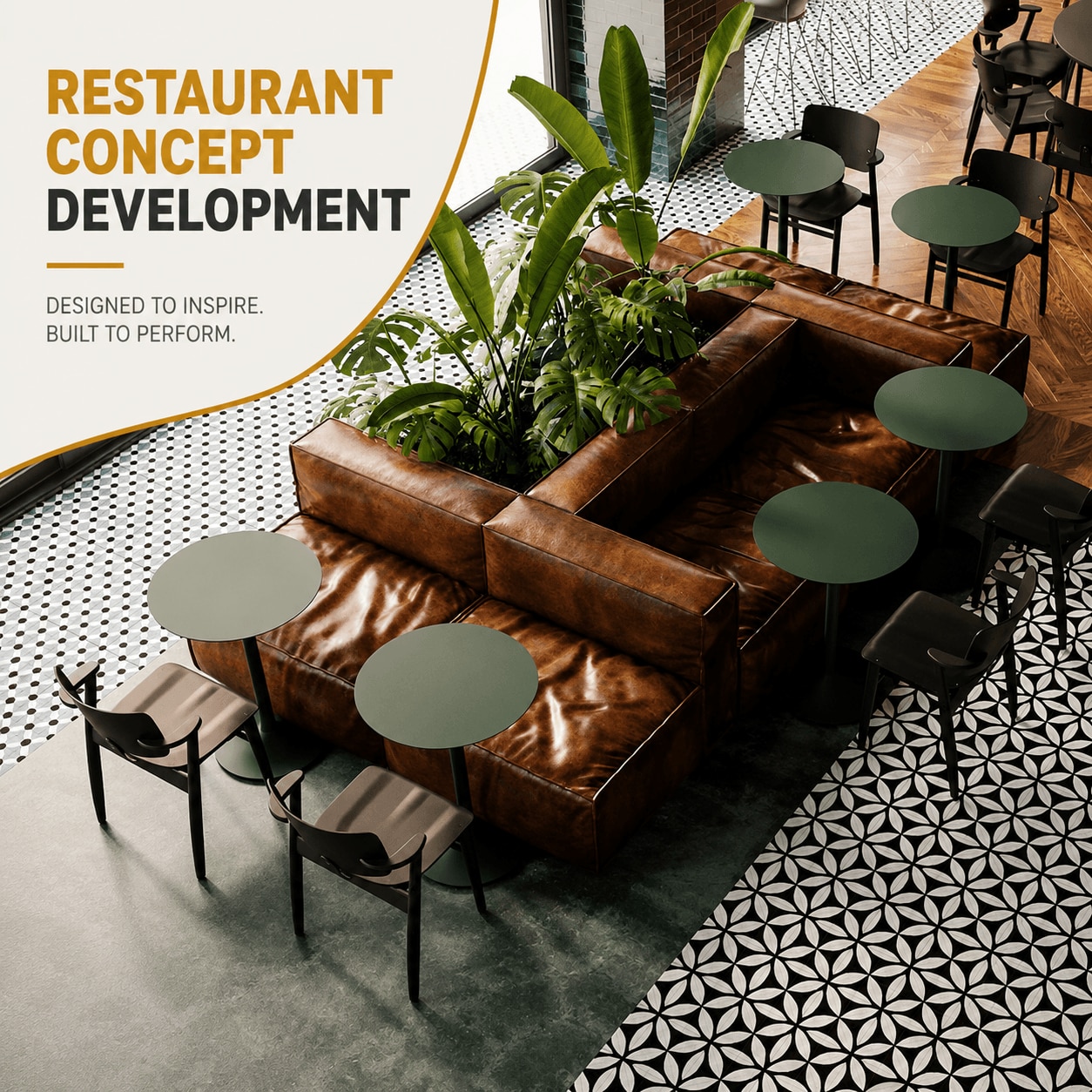 | F&B Concept & Feasibility Consulting Restaurant Concept Development A restaurant concept needs to answer a fundamental question: what experience is the customer actually being invited to buy? Cuisine alone does not... View product → |
Frequently asked questions
What is the first step in F&B concept development in Delhi NCR?
The process starts with an operating brief, not a logo or menu. It defines the target customer, offer, price, location and service channels.
How is a food business concept tested in Delhi?
The catchment and site are assessed against real NCR demand, including customer patterns, competition, access, delivery potential and commercial constraints.
Why compare alternative foodservice formats before selecting one?
Comparing formats reveals differences in investment, staffing, kitchen requirements, service speed, customer experience and operating risk before you commit.
What does a feasibility sign-off test?
It checks the preferred concept against the site, menu, operating model and financial projections, while a pilot exposes risks that spreadsheets can miss.