Informal shadowing cannot reliably control order errors, unsafe food handling, delayed service or inconsistent guest recovery across a hotel operation. By the end, you will be able to identify the roles and risks that require formal training, build a Delhi NCR-specific programme and judge whether it is improving measurable results.
Key takeaways
- Train formally when repeated service failures affect multiple employees.
- Teach each role its own service, safety, and communication standards.
- Use short shift-based sessions supported by demonstrations and checklists.
- Measure training through ticket times, errors, complaints, waste, and sales.
When Does a Hotel Need Formal Restaurant Staff Training?
Informal onboarding is no longer enough when the same service failures keep returning after coaching. Formal hotel staff training is needed when inconsistent portioning, wrong orders, delayed ticket times, weak complaint handling, unsafe food practices, poor upselling or kitchen-service communication gaps affect more than one employee.
Use this diagnostic procedure:
- Review guest complaints for repeated issues such as missing items, incorrect temperatures or unresolved complaints.
- Count food returns and compare ticket-time variance by shift, outlet and meal period.
- Check voids, discounts and order corrections for patterns linked to POS entry or approval practices.
- Compare mystery-audit scores across restaurants, breakfast service, room service and banquets.
- Record hygiene observations, including handwashing, glove use, storage and cleaning failures.
- Compare absenteeism and turnover with service breakdowns; constant replacements expose weak induction.
- Track repeated training failures, such as staff passing a briefing but repeating the same task error.
- Identify whether kitchen and service teams use different portion, dispatch or escalation instructions.
A pattern across shifts or outlets indicates a system problem, not one careless employee. Food and beverage training for hotels must then define the task standard, demonstrate it at the workstation, provide supervised practice and require a recorded sign-off. Without those four controls, hotel staff training becomes attendance-taking rather than proof of competence.
What Should Each Hotel Role and Outlet Learn?
Use one common core for hygiene, workplace conduct, guest handling and service sequence, then add modules for each outlet. Restaurant staff training in Delhi must reflect the property’s menu, POS, kitchen layout, room-service route, banquet setup and emergency procedures.
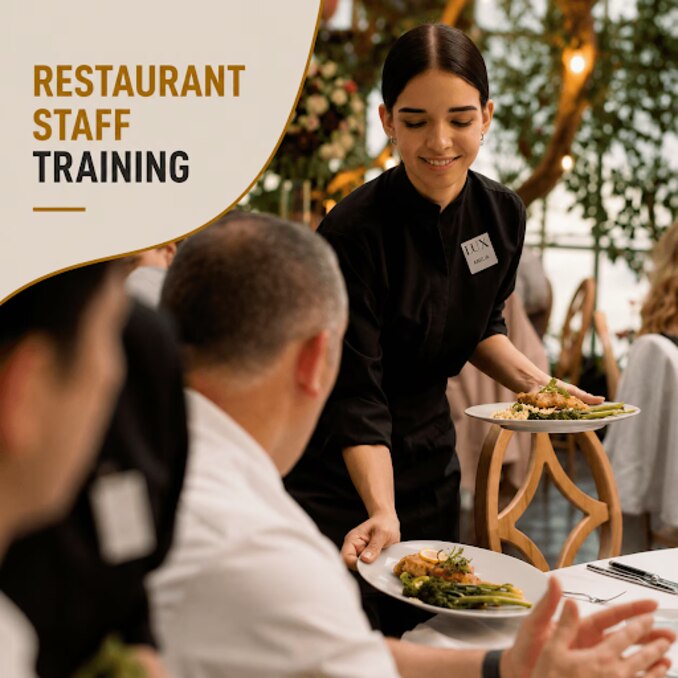
1. Waitstaff and captains practise greeting, order taking, allergen communication, service sequence, POS entry, billing, beverage service and guest recovery. Breakfast teams rehearse rapid seating and order accuracy during the morning peak.
2. Stewards learn table resetting, tray carrying, breakage handling and hygiene. Supervised practice matters: a signed attendance sheet does not prove safe tray movement or correct glass handling.
3. Bartenders learn recipes, measures, responsible alcohol service, identification checks, refusal language and escalation. They must know when to involve a supervisor instead of arguing with a guest.
4. Chefs and kitchen helpers practise mise en place, portion control, thermometer use, cross-contamination prevention and dispatch communication. The pass team must match tickets, modifiers and pickup timing before food leaves the kitchen.
5. Room-service staff train on tray loading, route control, delivery timing and collection. They need a clear method for doors, calls, missing items and unattended trays.
6. Banquet teams practise room setup, buffet replenishment, high-volume service and event changes. Weddings, conferences and live counters require different station plans.
7. Hosts, supervisors and duty managers train on seating control, complaint escalation, shift briefings, incident logs and coaching. Food and beverage training for hotels works best at the workstation, with visual SOPs and job aids in the languages staff use.
Which Training Format Works Across Delhi NCR Shifts?
Use a layered format, not one lecture: induction establishes safe conduct, station training proves task competence, cross-training adds coverage, refreshers correct failures, and supervisor development sustains the standard.
| Format | Main purpose | Delivery and evidence |
|---|---|---|
| Induction | Conduct, personal hygiene, handwashing, illness reporting, emergencies and basic guest handling | Visual SOPs, translated job aids and a short check |
| Station training | POS order entry, tray handling, table resetting and allergen communication | Workstation demonstration followed by supervised sign-off |
| Cross-training | Breakfast, banquets, room service and one additional station | Separate practice for each workflow; never assume automatic transfer |
| Refresher training | Audit findings and repeated errors | Targeted correction, then observed recheck |
| Supervisor development | Briefings, observation, feedback, incident reporting and corrective action | Shift huddles, coaching practice and documented follow-up |
This structure fits multilingual teams, high turnover and split shifts across Delhi, Gurugram, Noida, Ghaziabad and Faridabad. Run demonstrations at the point of work, use short shift huddles before breakfast surges, and replace attendance-sheet completion with practical observation.
For hospitality staff training ncr in delhi, translate critical job aids into the languages your team uses and show the task beside the POS, pass, room-service route or banquet set-up.
A hotel staff training ncr in delhi programme also needs separate sign-offs for each outlet: a banquet server who handles plates well has not automatically proved breakfast buffet control or room-service delivery. Inspectors, supervisors and managers should record failed steps, assign a focused refresher and verify the correction on the next relevant shift.
Which Compliance Controls Must Hotel Training Cover?
Put compliance into the training programme, not a separate binder. A forgotten procedure at breakfast or behind the bar becomes a service failure, unsafe meal or licence breach when nobody has practised it.
FSSAI Schedule 4 training must include:
- Personal hygiene, handwashing, illness reporting, cross-contamination prevention, cleaning and sanitising, pest control and waste handling.
- Cold holding at 5°C or below, hot holding at 60°C or above, and reheating to at least 70°C.
- Thermometer use, temperature logs, corrective action and verification. Assess these through observation and records, not attendance sheets.
FoSTaC coverage is also a staffing control: provide at least one trained Food Safety Supervisor for every 25 food handlers. That supervisor leads on-site food-safety training and implementation, then checks whether each shift follows the procedure.
| Control area | Common training | Local document or authority |
|---|---|---|
| Food safety | FSSAI hygiene, temperatures, cleaning and records | FSSAI registration or licence conditions |
| Alcohol service | Identification checks, permitted products, hours, responsible refusal and escalation | Delhi, Haryana or Uttar Pradesh excise licence |
| Workplace safety | Fire response, labour procedures, POS and incident records | State and municipal requirements |
For hotel staff training NCR in Delhi, separate these jurisdictions during induction; Delhi, Haryana and Uttar Pradesh are not one licensing area. Add sexual-harassment prevention for every team, with Internal Committee awareness where the establishment has 10 or more workers.
Food and beverage training for hotels must make staff practise refusal, escalation, incident recording and POS corrections. Supervisors then verify performance during live shifts.
How Should a Hotel Prove That Training Is Worth the Cost?
Prove the return by comparing operating results before training with results after staff demonstrate the required tasks. Course attendance or a better satisfaction score cannot show that behaviour changed.
1. Record a baseline for food-temperature compliance, order-error rate, ticket-time variance, complaint volume, food returns, breakage, voids, discounts, upselling conversion and audit results. For restaurant staff training in Delhi, record cold holding at 5°C or below, hot holding at 60°C or above and reheating to at least 70°C.
2. Commission task-based modules, not a generic soft-skills course. Ask the provider to map each module to Tourism and Hospitality Skill Council role standards, the hotel’s menu, layout, POS, emergency procedures and applicable Delhi, Haryana or Uttar Pradesh licences.
3. Test each role in the workplace. A steward must carry a tray and communicate an allergen; a server must enter and correct a POS order; a cook must record a temperature and take corrective action; a supervisor must conduct a briefing and handle a complaint.
4. Review the same measures at 30, 60 and 90 days. Assign retraining to the failed task—such as POS correction or temperature logging—instead of repeating a generic lecture.
Vinship Restaurant Consultant can help connect hotel staff training to outlet workflows and measurable service controls, while the hotel retains ownership of assessment records, corrective actions and staff accountability.
Related products
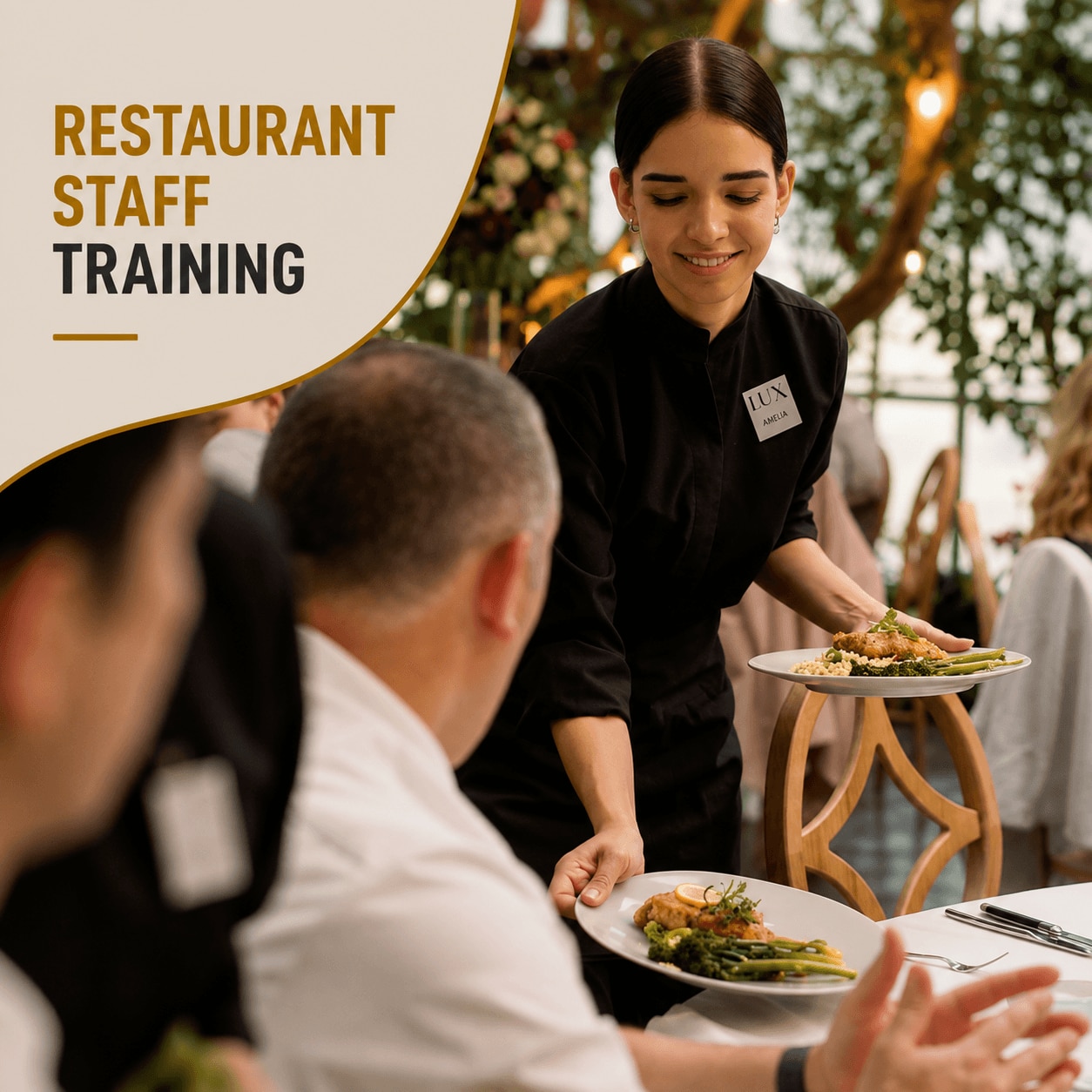 | F&B Training & SOP Development A restaurant's operating standards are ultimately delivered by its people. View product → |
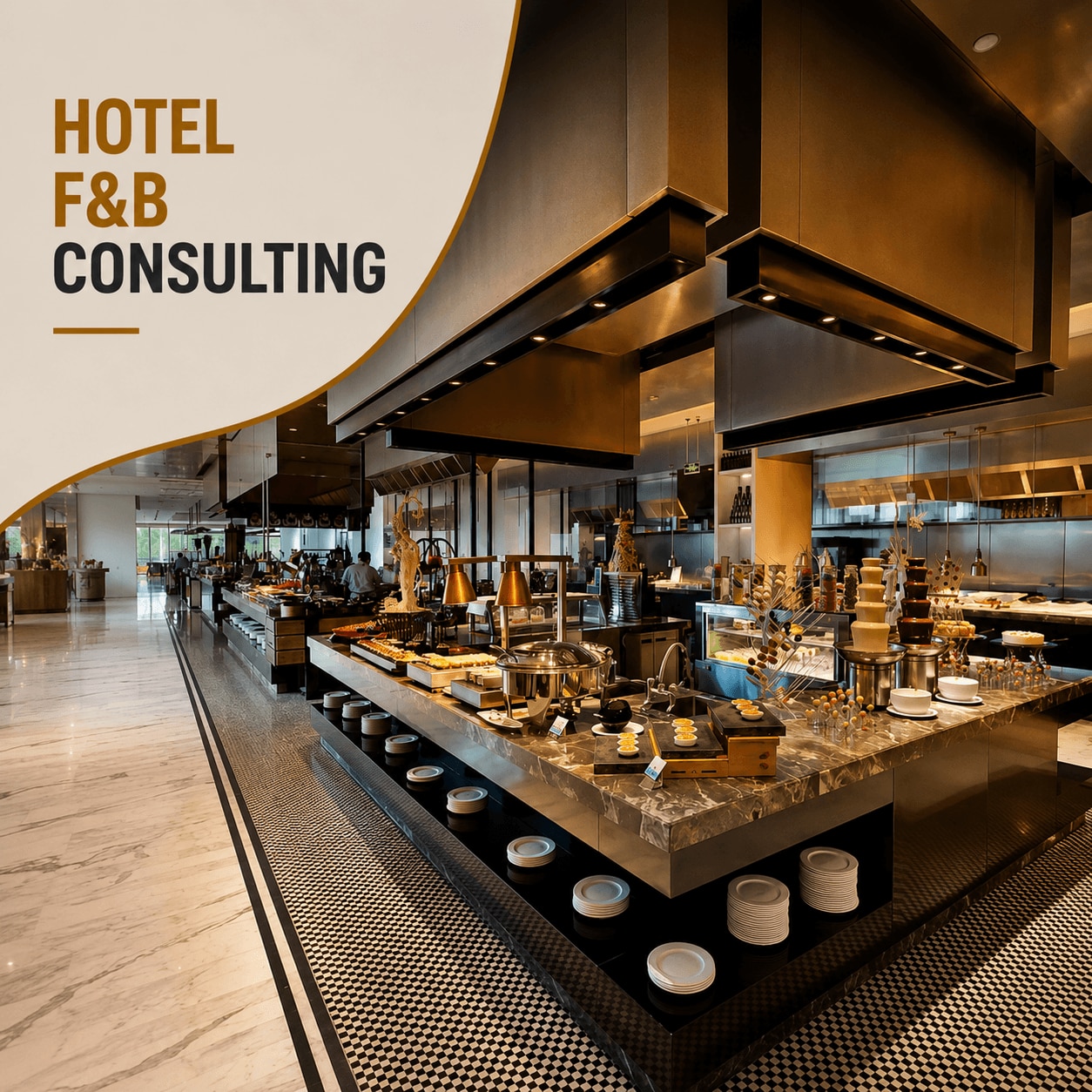 | Hospitality & Institutional Consulting Hotel food and beverage operations operate within a more complex environment than many standalone restaurants. View product → |
Frequently asked questions
When does a hotel need formal restaurant staff training?
Formal training is needed when recurring issues such as incorrect orders, inconsistent portions, slow ticket times, unsafe food practices, weak complaint handling, poor upselling, or kitchen-service communication gaps affect more than one employee.
What should each hotel restaurant role learn?
Servers need menu knowledge, order accuracy, complaint handling, and upselling skills. Hosts need reservations and guest-flow procedures. Kitchen staff need recipes, portion control, food safety, and ticket communication. Supervisors need coaching, escalation, and shift-control skills.
Which training format works across Delhi NCR hotel shifts?
Use short, role-specific sessions during shift overlaps, followed by demonstrations, observed practice, checklists, and refresher coaching. Keep the same standards across outlets and shifts while adapting examples to the hotel’s operation.
Which compliance controls must hotel training cover?
Training should cover food-handler hygiene, handwashing, temperature control, allergen communication, cross-contamination prevention, cleaning records, pest-control reporting, licence documentation, and incident escalation.
How can a hotel prove that training is worth the cost?
Compare baseline and post-training measures such as ticket times, order errors, guest complaints, food waste, voids, average check value, staff retention, audit scores, and repeat coaching hours.