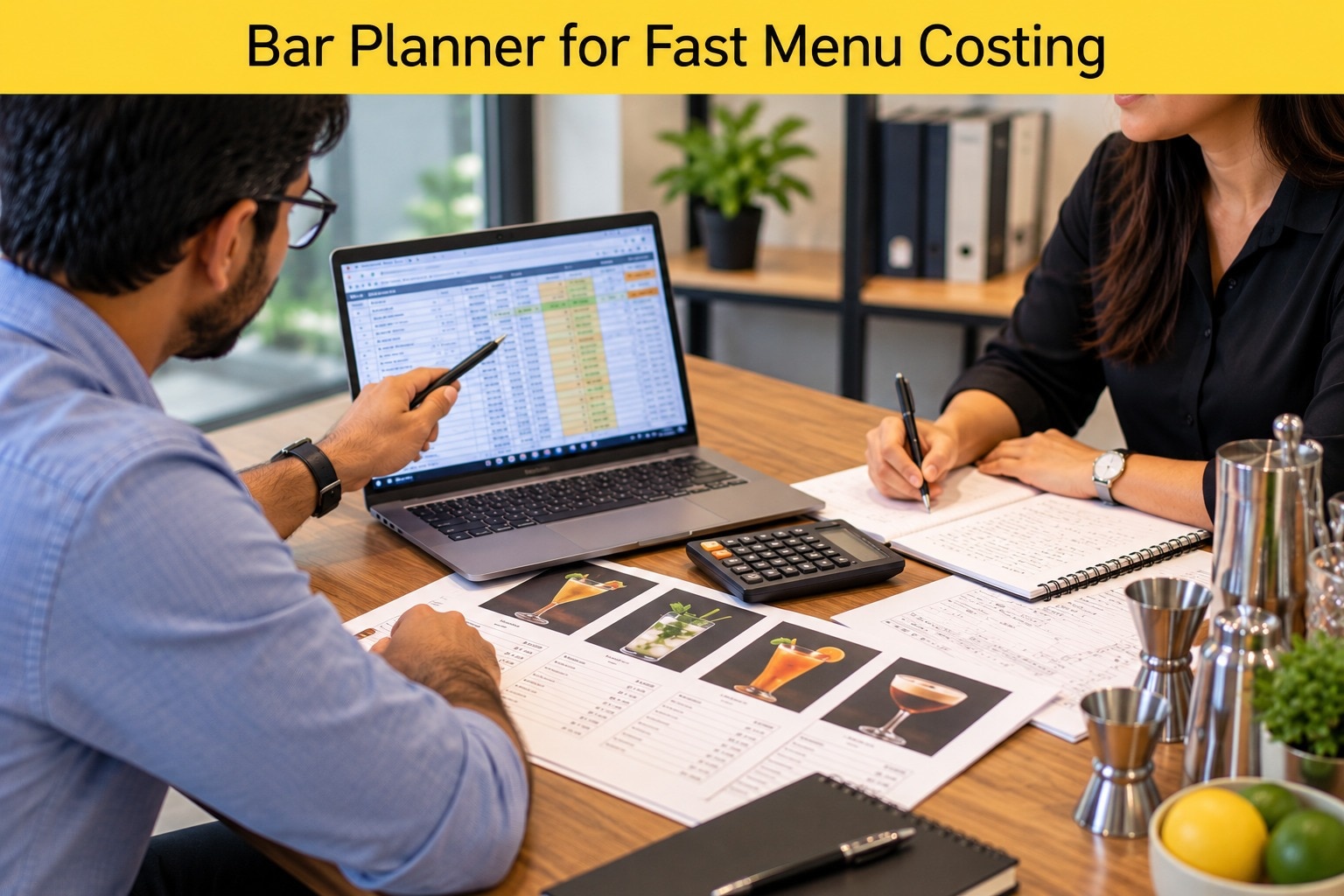
Fast costing depends on clean inputs, correct pour measures and a workbook that separates recipe cost from stock variance. You will be able to prepare the right brief, test a planner’s method, check Delhi and NCR pricing constraints, and judge whether the final workbook is ready for service and future price changes.
Key takeaways
- Give the planner recipes, pour sizes, purchase prices and expected selling prices.
- Cost spirits, mixers, garnishes, ice, wastage and service portions separately.
- Price batch cocktails by finished yield, not by the original bottle count.
- Compare recipe cost with actual pour variance after opening the bar.
What a fast bar-costing assignment must produce
Send a bar planner for menu costing near me in Delhi a complete brief before asking for speed.
Include outlet location, service format, licence category, menu categories, number of recipes and SKUs, POS export, supplier price list, purchase invoices, bottle sizes, standard pour sizes, batch recipes, garnish list, wastage assumptions, tax treatment, and planned launch or revision date. Speed depends on complete source data, not a promised turnaround.
Ask the planner to confirm:
- Turnaround time, fee, recipes included, revision rounds, and whether coverage is Delhi-only or includes NCR outlets
- An ingredient master with IDs, pack quantity, purchase unit, bottle or case size, supplier price, usable yield, recipe unit, and conversion factor
- Recipe cards, a batch-yield sheet, pricing sheet, and revision-history tab
- Deliverables covering cost per serve, gross profit in rupees, beverage-cost percentage, recommended price bands, standard portions, service assumptions, tax notes, and a change log
A useful workbook lets one supplier-price change flow through every affected drink. It must not mix case prices, bottle sizes, millilitres, and portions without a conversion layer.
Test it with a revised vodka price. Every cocktail using that vodka should update without manual editing. If the planner must alter each recipe, the workbook is slow regardless of the promised turnaround.
How to cost every drink component and pour
1. Cost each pour from usable volume, not bottle price alone: bottle cost ÷ usable millilitres × serving millilitres. A Rs 3,000, 750 ml bottle gives 25 theoretical 30 ml serves or 12.5 60 ml serves before loss. Reduce usable volume for measured over-pours, line loss, breakage, spillage and residue.
2. Put every cocktail component on its recipe card: base spirit, modifiers, bitters, syrups, juices, carbonation, purchased ice, pre-batched dilution and garnish. Add straws, napkins, coasters, welcome shots and complimentary mixers; omitted service items create a recurring margin error.
3. Yield-test citrus, herbs, fruit and infusions. Record purchase weight or volume, trim, spoilage, finished yield and portions obtained, then cost the usable yield rather than the invoice quantity.
4. For example, a cocktail with a 30 ml spirit cost of Rs 180, other liquids at Rs 70, garnish at Rs 15, and ice and consumables at Rs 10 costs Rs 275 before wastage. Adding 5 percent wastage gives Rs 288.75; at a 25 percent beverage-cost target, the calculated selling price is Rs 1,155.
5. Apply the same worksheet to highballs, beer, wine pours and non-alcoholic drinks using each pack’s size, usable yield and serving measure. A bar menu costing consultant in Delhi should also show the conversion from cases, bottles, cans or cartons to millilitres and portions.
Ask for menu pricing help for bars that preserves these inputs instead of hiding them in a guessed unit price.
Batch cocktails, taxes and the Delhi-NCR price check
A batch quote changes when yield, jurisdiction and service format change. Use this formula: total batch cost ÷ saleable portions.
1. Record every ingredient, pre-dilution volume, measured dilution, serving size, expected transfer loss and final yield. A 3,600 ml batch costing Rs 4,800, with 600 ml dilution and 120 ml transfer loss, yields 4,080 ml: 27 portions at 150 ml. Cost is Rs 177.78 per portion before garnish and service consumables.
2. Show dilution separately. It increases saleable volume, but it does not reduce the spirit cost already in the batch. Price garnish, ice, straws and other consumables against the final portion count.
3. Prepare separate price sheets for Delhi, Gurugram, Noida, Ghaziabad and Faridabad. A bar planner handling menu pricing in Delhi and NCR must check each jurisdiction’s excise notifications, approved price lists, licence conditions, brand availability and permitted service format; distributor invoices alone miss those constraints.
4. State the tax model: alcoholic liquor for human consumption is outside GST; food, non-alcoholic items and separately billed services require their applicable GST treatment. Record whether input tax credit is excluded, restricted or available, and explain service-charge treatment rather than burying it in the menu price.
5. Include rent burden, labour burden and outlet positioning in the price decision. A luxury hotel, neighbourhood bar and high-volume venue cannot share one margin target.
6. Keep FSSAI licensing and food-safety controls visible. A substitution that changes allergens, labelling or preparation controls requires revised records and handling instructions.
Recipe cost is not the same as actual pour cost
A correct recipe can still produce an unprofitable bar because the bottle count does not match what the POS says you sold.
| Measure | Calculation | What it reveals |
|---|---|---|
| Theoretical recipe cost | Standard-card ingredients and portions ÷ selling price | Whether the recipe and menu price meet the target |
| Actual cost | Opening stock + purchases − closing stock | What stock movement actually consumed |
| Contribution margin | Selling price − variable drink cost | Rupees available for labour and overhead per serve |
Compare actual depletion with recorded POS sales and standard recipe depletion. Investigate gaps caused by over-pouring, unrecorded comps, waste, theft, breakage, spillage, incorrect bottle counts and batch loss.
Use the menu-price formula: price = total cost ÷ target cost percentage. Then test the commercial result: selling price − variable drink cost = gross profit per serve. Compare that rupee contribution with preparation time, sales volume, labour use and bar capacity.
A drink with a 20 percent recipe cost can still be a poor choice if it occupies a station for four minutes or uses an ingredient that spoils before it sells.
Require these controls in the brief, even if you found the provider through “restaurant food costing consultant near me”:
- Daily or weekly 30 ml and 60 ml peg checks, measured jiggers and open-bottle counts by bottle size.
- Cocktail-yield and batch-loss records, plus POS-to-stock reconciliation.
- Written variance thresholds, stock-count frequency and one owner for each corrective action.
How to choose and brief the right Delhi planner
Choose the planner whose workbook handles beverage controls, not just ingredient totals. “bar menu costing consultant in Delhi” and “restaurant food costing consultant near me” describe search results, not proof that the provider understands pours, bottle depletion or excise assumptions.
| Check | Beverage-capable planner | Generic costing provider |
|---|---|---|
| Template | Bottle-size conversion, 30 ml and 60 ml peg mapping, batch yield and mixers | Ingredient price and recipe total only |
| Controls | Wastage, open-bottle counts, POS reconciliation and revision history | No stock-to-sales check |
| Location | Separate Delhi, Gurugram, Noida, Ghaziabad and Faridabad models | One NCR price sheet |
| Commercial output | Contribution per serve, taxes, service charge and price ladder | Recommended selling price only |
Ask for an anonymised bar template and test whether one revised vodka price updates every affected drink without manual editing.
- Request the scope in numbers: recipes, SKUs, supplier lists, POS files, site visits, staff training, revision rounds and final file formats.
- Confirm who verifies Delhi excise notifications, licence conditions, brand availability and tax assumptions before publication.
- Include batch recipes, complementary mixers, standard pours, stock reconciliation and a change log in the brief.
Vinship Restaurant Consultant is worth considering when menu pricing help for bars must connect costing with practical bar operations; judge the engagement by its workbook and controls, not its label. Accept only when staff can reproduce each cost, managers can update prices once, and owners can see contribution and stock variance.
Confirm the fee and turnaround after reviewing source files and recipe count.
Related products
 | Menu Engineering & Food Costing Food cost is one of the fundamental commercial considerations in foodservice. View product → |
 | Menu Engineering & Food Costing A restaurant menu is both a customer-facing offering and a commercial operating tool. View product → |
Frequently asked questions
What should a fast bar-costing assignment produce?
Ask for a drink-by-drink costing sheet, standard recipe cards, gross-margin calculations, batch yields, tax treatment and recommended menu prices.
How do you cost every drink component and pour?
Record each ingredient’s purchase unit, usable yield, recipe quantity, pour size, garnish, ice, mixer and wastage allowance before calculating the drink cost.
How should batch cocktails, taxes and Delhi-NCR prices be checked?
Cost the full finished batch, divide by its measured yield, separate GST from the menu price, and compare the result with competing Delhi-NCR venues.
Why is recipe cost different from actual pour cost?
Actual pour cost includes overpouring, spillage, breakage, staff drinks, expired mixers, unrecorded comps and stock-count differences.
How do you choose and brief a Delhi bar menu costing planner?
Give the planner your concept, menu, recipes, bottle invoices, licence constraints, service format, target margins, opening date and required deliverables.
Keywords