
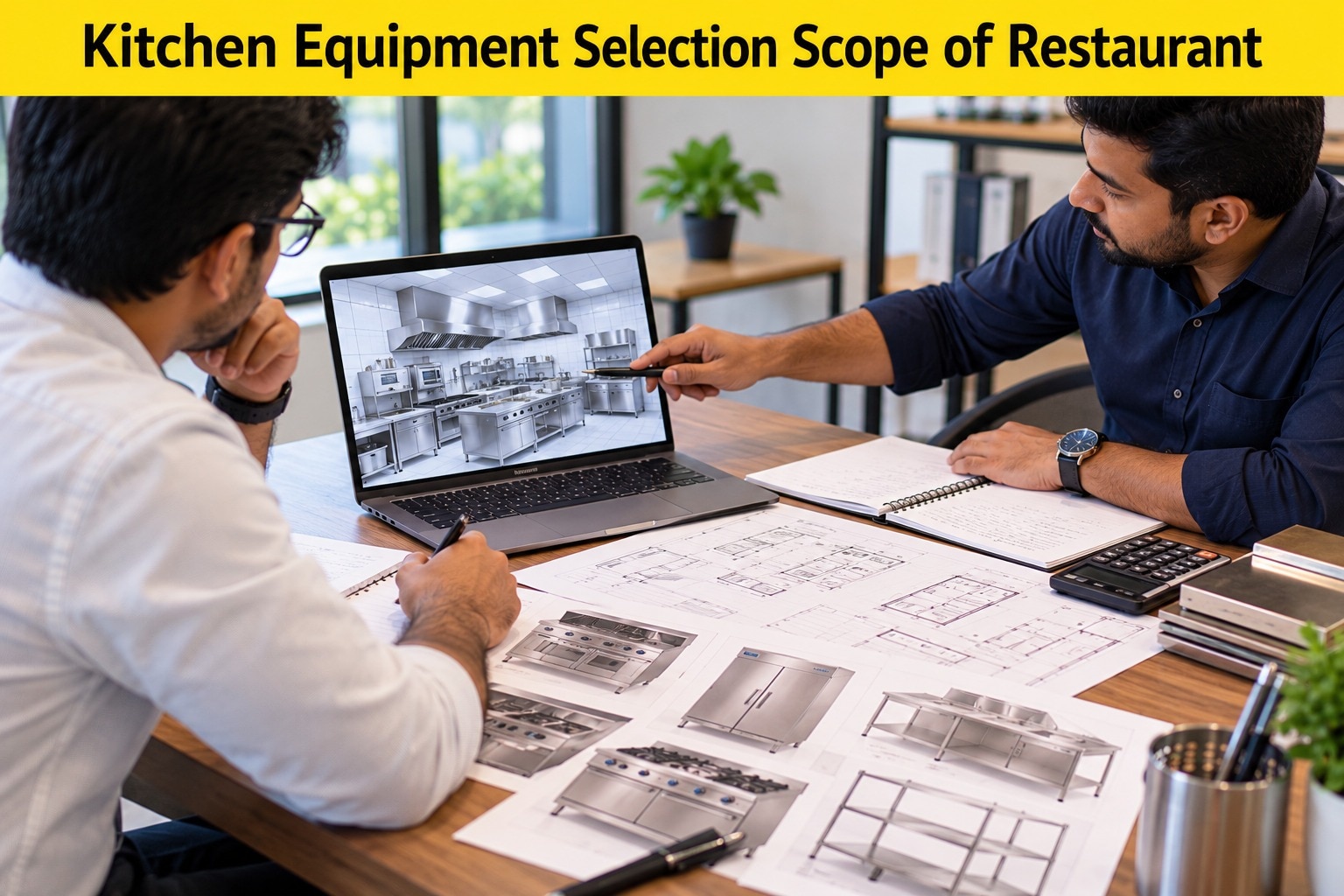
A usable equipment scope starts with covers, recipes, peak-hour demand and site utilities, then turns those facts into capacities, connections, responsibilities and acceptance tests. By the end, you will have a room-by-room schedule and procurement checklist that can be priced, coordinated and commissioned for a Delhi restaurant.
Key takeaways
- Calculate equipment capacity from peak covers, batch size and production time.
- Assign cooking, storage, wash-up and waste equipment to defined work areas.
- Verify Delhi power, water, drainage, exhaust and approval constraints before ordering.
- Include dimensions, utilities, performance criteria and acceptance tests in every equipment schedule.
What inputs determine the equipment scope and capacity?
Collect the operating brief before opening an equipment catalogue. For facility planner kitchen equipment selection for scope in Delhi, record the menu matrix, recipes, batch sizes, production methods, peak-period sales mix, covers per hour, holding times, service hours, delivery schedule, storage days, staff count and available electrical load.
Calculate peak-hour demand, not average daily sales, with separate allowances for raw, ready-to-eat, frozen and waste streams.
Convert those figures into measurable capacities:
- Burner count equals simultaneous pan loads, including recovery time between batches.
- Oven size equals batch weight divided by usable chamber load, checked against required recovery time.
- Fryer capacity equals peak fried portions per hour plus oil-recovery demand between loads.
- Refrigerator volume equals product-category volume, storage days and delivery frequency, with raw, ready-to-eat and waste segregation.
- Prep-table length equals the number of parallel tasks, such as trimming, portioning and plating.
- Dishwashing throughput equals peak racks per hour, with separate dirty-to-clean movement and hot-water capacity.
| Production model | Equipment and capacity effect |
|---|---|
| Cookline | More burners, extraction, hot holding and backup capacity at service |
| Central prep | More transport, bulk refrigeration and production redundancy; smaller outlet prep |
| Cook-chill | Blast chilling, chilled storage, regeneration equipment and tighter holding controls |
Choose redundancy when one failed appliance stops service. Recipe-level restaurant facility planner equipment advice must also test staff workflow and electrical load, because a nominally suitable machine can overload the panel or exceed available labour.
Which equipment belongs in each kitchen room or work area?
Build the schedule by room and food-flow direction, then assign every item to capital equipment, building services or loose operating items. This is the core of commercial kitchen equipment planning in Delhi.
- Receiving: platform scales, inspection bench, pallet or trolley access, receiving racks and a marked quarantine bay for rejected goods.
- Dry storage: adjustable shelving, ingredient bins, stock-rotation space and sealed, pest-resistant storage.
- Cold storage: separate refrigerator and freezer capacity; raw and ready-to-eat segregation; shelving clearances; 1–5°C refrigeration and −18°C or colder freezing. Record door-opening frequency, recovery time, alarms, condenser ventilation and manual or automatic defrost.
- Preparation: handwash points, sinks, worktables, colour-coded cutting boards, food processors, mixers, slicers and prep refrigeration.
- Cooking: ranges, ovens, fryers, grills, steam equipment and hot holding, coordinated with hood extraction, gas shut-off, fire suppression and electrical isolation.
- Plating: pass counters, heat lamps for hot dishes and chilled surfaces for cold food.
- Dishwashing: dirty-side scrap tables, pre-rinse spray, racks, dishwasher or pot-wash equipment, clean storage and a one-way dirty-to-clean route.
- Waste: segregated bins, grease management, washable walls and floors, and a removal route that avoids food preparation.
| Classification | Include | Responsibility |
|---|---|---|
| Capital equipment | Ovens, refrigeration, fryers, sinks, shelving, dishwasher | Equipment supplier |
| Building services | Panels, gas manifolds, ducts, fire suppression, drainage, HVAC, water treatment | Architect or MEP team |
| Loose operating items | Bins, boards, racks, utensils and containers | Operator |
Which Delhi site, utility and approval checks must precede selection?
Do not approve an appliance from the kitchen drawing alone. A kitchen equipment selection consultant in Delhi must prove that each item can enter, connect, operate, be cleaned, serviced and legally approved at the actual premises.
- Record sanctioned electrical load, voltage, single-phase or three-phase supply, spare panel capacity and isolation points.
- Confirm LPG cylinders or piped gas, gas type and pressure, regulator compatibility, shut-off controls, leak detection, ventilation and appliance clearances.
- Measure water pressure, potable-water points, hot-water demand, drainage size and invert, floor falls, grease traps or interceptors, and discharge locations.
- Survey monsoon moisture, ventilation risks, external condenser space, ceiling and shaft clearances, slab loading, lift capacity, delivery-route dimensions, doors, stairs and replacement access.
| Site check | Record | Selection consequence |
|---|---|---|
| Electrical | Load, phase, voltage, panel capacity | Reject equipment that overloads the supply |
| Gas | Fuel, pressure, regulators, storage and shut-offs | Confirm appliance compatibility and approval responsibility |
| Drainage | Pipe diameter, invert, falls and discharge | Prevent backflow, ponding and unusable dishwashers |
| Access | Lift, doors, stairs, route and service space | Confirm delivery, installation and future replacement |
Commercial kitchen equipment planning in Delhi must coordinate hood type, appliance duty, duct route, grease filters, cleaning access, make-up air, fire suppression, noise, heat gain and exhaust restrictions. Hood length alone cannot size extraction.
Tie the schedule to FSSAI hygiene provisions, Delhi Fire Service requirements, the Gas Cylinders Rules, 2016 and PESO responsibilities for LPG or compressed-gas storage. State who obtains approvals and designs the gas system.
What makes an equipment schedule procurement-ready?
A procurement-ready schedule is the performance and coordination brief, not a list of appliance names. It states what each item must do, how it connects, and who completes the interface.
| Role | Issued document | What it proves |
|---|---|---|
| Facility planner | Equipment schedule and utility matrix | Capacity, performance, interfaces and responsibility |
| Kitchen designer | Plan and elevations | Location, clearances, workflow and installation geometry |
| Vendor | Commercial quotation and data sheets | Offered model, price, delivery and stated specifications |
| Architect or MEP consultant | Building-services drawings | Panels, gas, water, drainage, HVAC, ducts and structural provisions |
Every schedule line must identify:
- Item name, tag, quantity, dimensions, capacity and operating temperature where relevant
- Connected electrical load, phase, voltage, gas consumption, gas type and pressure
- Water inlet, hot-water demand, drainage connection, exhaust requirement and fresh-air need
- Material grade, warranty, service terms, spare-parts requirement and installation responsibility
Attach manufacturer data sheets, plan and elevations, the utility matrix, ventilation and heat-load assumptions, commissioning tests, training requirements and exclusions. State whether the supplier or project team provides panels, gas manifolds, ducts, fire suppression, civil bases, drainage, HVAC, water treatment and installation testing.
For restaurant facility planner equipment advice, this detail prevents a quoted oven or dishwasher from arriving without a usable connection. A kitchen equipment selection consultant in delhi, such as Vinship Restaurant Consultant, can then test proposals against the operating brief rather than compare appliance names alone.
How should Delhi restaurant equipment be compared, commissioned and accepted?
Choose the lowest whole-life cost, not the lowest quote. A facility planner kitchen equipment selection for scope in Delhi must compare each technically suitable option against the site’s utilities, workload and service conditions.
| Option | Cost and utility comparison | Service comparison |
|---|---|---|
| Electric | Purchase price, connected load, standby energy, water use, extraction and heat-rejection effects | Preventive maintenance, cleaning chemicals, cleaning labour, downtime and useful life |
| Gas | Purchase price, gas consumption, pressure requirement, water use, extraction and heat-rejection effects | Combustion servicing, consumables, downtime, useful life and safety checks |
| Any option | Include Delhi/NCR spare-part availability and replacement lead time | Reject a saving that creates long outages or costly local repairs |
Use BEE standards and labelling when the relevant appliance category is covered; many commercial-kitchen appliances have no comparable BEE label. Appoint a kitchen equipment selection consultant in Delhi to document the comparison rather than accept a vendor’s nameplate alone.
Set acceptance tests before purchase and record signed results:
- Measure electrical load, gas pressure and combustion where applicable.
- Verify extraction airflow or capture at the appliance, not only at the hood.
- Test refrigeration pull-down and recovery, dishwasher rinse or sanitising performance, hot-water recovery, drainage and operating noise.
- Demonstrate cleaning, shutdown and routine access.
Require manuals, shutdown procedures, warranty contacts, operator training and service escalation details. Reject equipment that lacks service access, utility capacity, safe clearances or a credible Delhi/NCR repair route, even when it fits the drawing.
Frequently asked questions
What inputs determine a Delhi restaurant kitchen equipment scope?
Use the menu matrix, recipes, batch sizes, production methods, peak-period sales mix, covers per hour, holding times, service hours, delivery schedule, storage days, staff count and available electrical load.
Which equipment belongs in each restaurant kitchen work area?
Map equipment to receiving, dry storage, cold storage, preparation, cooking, hot holding, plating, warewashing, waste handling and staff-support areas. Keep the workflow moving from delivery to service without crossing dirty and clean routes.
Which Delhi site and utility checks must precede equipment selection?
Confirm room dimensions, access routes, floor loading, electrical phase and connected load, LPG or piped-gas availability, water pressure, drainage points, grease-trap location, exhaust discharge, make-up air, fire systems and required local approvals.
What makes a kitchen equipment schedule procurement-ready?
List each item’s quantity, location, dimensions, capacity, construction, power, gas, water, drainage, ventilation, controls, accessories, installation requirements, warranty and performance acceptance criteria.
How should restaurant equipment be compared, commissioned and accepted?
Compare lifecycle cost, output, recovery time, energy use, service support, spare parts and cleanability. Commission each item against documented tests for temperature, capacity, safety controls, drainage, ventilation and operator training.
Keywords